
What Dental Treatments Can Be Done in an Aged Care Home?
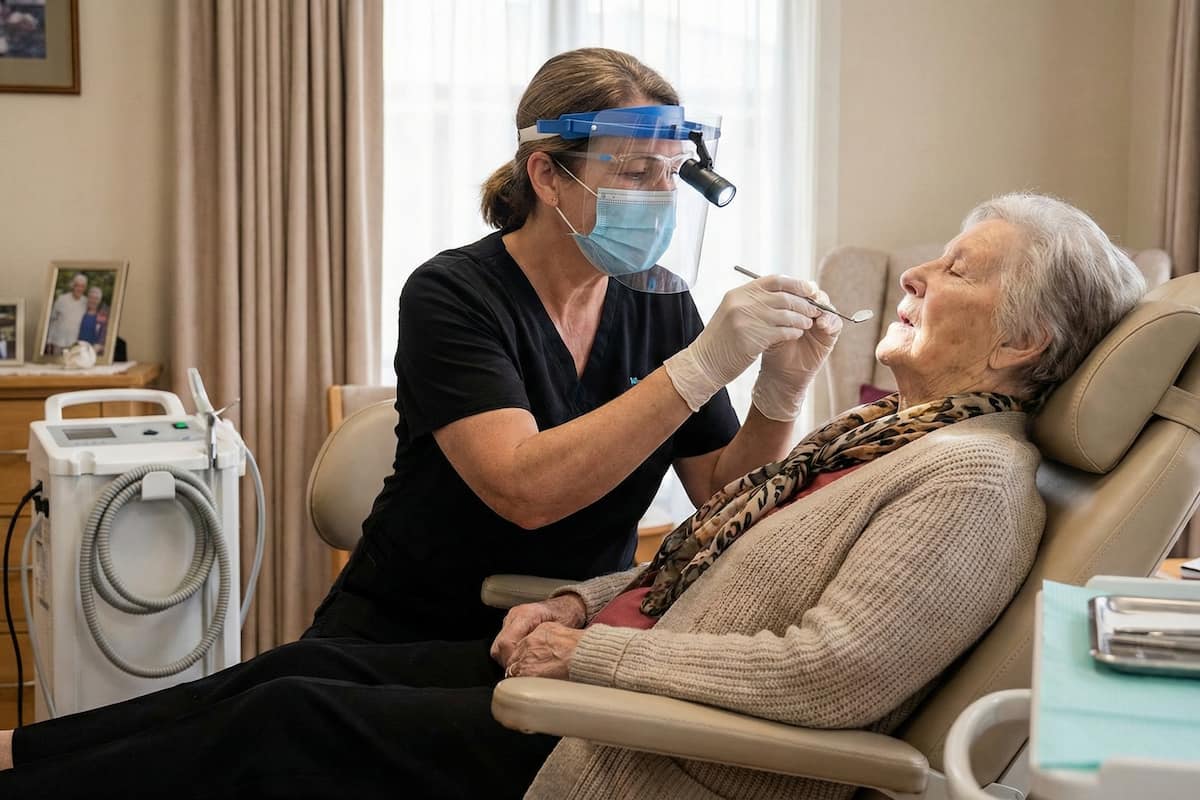
A visiting dentist can do more than look in the mouth and suggest a trip to a clinic. Portable equipment allows a range of assessments and treatments to be offered where an aged care resident lives. The important qualification is that no treatment list can tell you, on its own, what is suitable for a particular person.
The tooth matters, but so do the resident's health, wishes, medicines, ability to tolerate the visit and the safety of the setting. Some care can be completed at the bedside or in a suitable chair. Other care needs several visits, specialist input or a hospital. This guide explains the options and the questions to discuss at assessment.
Assessment and imaging come first
A dental assessment starts with the concern that prompted the appointment, alongside medical history, medicines and an examination of the mouth. Tell the team about swallowing problems, breathing conditions, recent hospital treatment and previous difficulties during dental visits. Information from the resident, authorised supporters and care staff can help the dentist plan a manageable appointment.
X-rays may be recommended when they are needed to answer a clinical question. Aged Care Dentistry offers portable imaging, allowing selected images to be taken on site when positioning and the resident's tolerance permit. Images can reveal information not visible in an examination, but they do not guarantee that every condition can be assessed in one visit. Sometimes different imaging or referral is necessary.
Ask what the assessment has established, what remains uncertain and which options are reasonable. Treatment should follow an informed discussion, appropriate consent and an explanation of costs. An appointment is not a commitment to proceed with every proposed procedure.
Cleaning, prevention and fillings
Professional cleaning and preventive care can often be adapted to a resident's needs. The team may recommend changes to daily brushing, denture care or dry-mouth management, or consider fluoride products according to decay risk. The care plan should be realistic for the person and the staff helping them, rather than a routine they cannot comfortably maintain.
Difficulty rinsing or spitting does not automatically rule out care. It does require an assessment of swallowing and airway risks. The clinician may adjust positioning, water use, instruments and suction. Portable suction is useful equipment, but it does not eliminate aspiration risk or make every procedure suitable at the bedside.
Many teeth can be treated with fillings. The approach depends on how much tooth remains, the location of the decay, moisture control, comfort and how long the resident can manage treatment. A shorter, less invasive approach may be useful in some circumstances. Other teeth need more extensive treatment, referral or a different plan.
Some early lesions can be managed preventively, while selected cavities may be stabilised with minimally invasive methods. These approaches still need diagnosis, consent and follow-up. They are not a promise that drilling is never needed or that a painful, infected tooth can simply be watched indefinitely. Ask the dentist what the proposed method is intended to achieve and how success will be reviewed.
Tooth extractions need individual risk assessment
An extraction may be considered when a tooth cannot be predictably restored or is causing a problem that another approach will not adequately address. Being older does not make extraction automatically preferable to saving a tooth. The likely benefit, alternatives, comfort and effect on eating all matter.
Some extractions can be undertaken in an aged care setting. Others are safer in a clinic or hospital because of surgical complexity, medical risk, positioning, airway considerations or the support needed afterwards. The plan includes both the procedure and what care will be available during recovery.
Medicines require particular attention. People taking anticoagulant or antiplatelet medicines should not stop them on their own before a dental appointment. Many procedures can be planned without stopping treatment, but decisions depend on the medicine, procedure and individual bleeding and clotting risks. The dentist and relevant medical clinician should agree any change and give clear instructions.
Tell the dentist about bisphosphonates, denosumab and other medicines used for osteoporosis or cancer, including past courses where known. Some are associated with a rare but serious jaw-healing problem. Risk depends on the drug, dose, reason for treatment, duration and the person's wider health. Do not delay or stop these medicines without advice from the treating clinicians.
Before an extraction, confirm who will receive the aftercare instructions, how pain relief will be managed and whom to contact if bleeding or other problems occur. Ask whether the resident will need additional monitoring, dietary adjustments or a review visit. These details are as important as the location of the procedure.
Denture assessment, adjustments and repairs
Mobile denture care can include checking fit, adjusting pressure areas, planning repairs or relines, and assessing whether a replacement is needed. New dentures usually involve a sequence of clinical and laboratory steps. The number of visits and repair turnaround depend on the work and the patient's circumstances.
A loose or painful denture deserves assessment, particularly if meals have become difficult. Do not glue a broken denture or try to reshape it yourself. Keep the pieces and ask the dental team how to proceed. A same-day repair may not be possible, so discuss a safe interim plan for comfort and eating.
If someone stops wearing a denture, ask why without assuming the answer. Poor fit, sore tissues, dry mouth, difficulty handling it, cognitive changes and personal preference are all possible factors. A review can help establish whether an adjustment, a different routine or another approach would be useful.
Unplanned weight loss needs wider assessment as well. Dental treatment may improve comfort but cannot be expected to solve every nutritional problem. Care staff, the GP, a dietitian or a speech pathologist may need to contribute, especially where swallowing or a prescribed food texture is involved.
Sedation is an option to assess, not an automatic next step
For some people, anxiety or difficulty tolerating treatment makes routine appointments challenging. Begin by discussing communication, a familiar supporter, a suitable time of day and shorter visits. These changes may help without adding the risks of sedation.
Aged Care Dentistry works with a mobile anaesthetic team for selected IV sedation cases. Sedation requires its own clinical assessment, consent, monitoring and recovery arrangements. The team must consider the procedure, medical conditions, medicines, airway, setting and available support before recommending it.
Sedation is not suitable for every resident and does not guarantee that all treatment can be completed in one visit. It should not be presented as inherently kinder than every alternative or used as a substitute for understanding distress. Sometimes the safest option is a different treatment plan, specialist care or a hospital setting.
When a different setting or treatment is needed
The right recommendation may be a referral rather than another attempt in the resident's room. Examples include a difficult extraction, a need for imaging or equipment unavailable on site, or medical and airway risks that require more support.
Root canal treatment may help preserve a suitable tooth. Whether it can be offered on site depends on the provider, the procedure and the person's ability to tolerate it; assessment may lead to a clinic or specialist referral. It is not accurate to assume that extraction or long-term observation is always the kinder choice for an older person.
Existing implants and implant-supported dentures also need appropriate review and cleaning. The type of maintenance or repair possible on site varies, and surgical treatment may require referral. Confirm the specific service rather than assuming every mobile provider offers every procedure.
For someone with advanced illness or approaching the end of life, comfort and the person's goals may lead to a less invasive plan. That remains active care: pain, infection and changing symptoms still need attention and a clear follow-up arrangement. Distress or resistance should prompt reassessment, not forced treatment.
What to ask after the assessment
- What is the problem, and what are the benefits and risks of each option?
- Can treatment be provided safely here, or is another setting needed?
- What happens if we defer or decline the proposed procedure?
- What costs, funding checks or separate anaesthetic fees need confirming?
- How many visits are likely, and what support will be needed afterwards?
- Who should staff or family contact if symptoms worsen?
If there is difficulty breathing or swallowing, rapidly spreading swelling or another life-threatening concern, call 000. Do not wait for a planned mobile appointment. For other urgent dental problems, seek prompt professional advice and explain the resident's symptoms and medical circumstances.
Discuss an on-site dental assessment
Our mobile dental service helps Perth residents access care when attending a conventional clinic is difficult. Call (08) 6558 1889 or use our contact page to discuss the situation, location and next available assessment. The team can explain what information to prepare and how suitable treatment options will be considered.
Frequently Asked Questions
It depends on the provider, equipment, tooth and resident’s needs. Root canal treatment can preserve a suitable tooth, but it may require referral to a clinic or endodontist. Frailty and appointment tolerance matter, alongside the likely benefit. Do not assume that extraction or monitoring is automatically preferable because someone lives in aged care.
Existing implants and implant-supported dentures need ongoing assessment and hygiene. Some care may be possible during a visiting appointment; other work requires specialised equipment or referral. Surgical implant placement needs a separate assessment and appropriate setting. Confirm the exact services available rather than assuming every implant problem can be managed in the resident’s room.
Aged Care Dentistry offers licensed portable dental imaging. The dentist decides whether an image is needed and whether it can be obtained safely and usefully in the setting. Patient positioning and tolerance may limit what is possible, and some investigations require another location. Imaging is used when clinically justified, not automatically at every appointment.
Often care can be adapted, but swallowing and airway risks must be assessed first. Changes to positioning, equipment, water use and suction may help. The person’s swallowing plan and relevant clinical advice should guide care. Portable suction does not remove every risk, so the clinician may recommend a modified approach or a different setting.
Do not stop or change anticoagulant or antiplatelet medicines yourself. Many dental procedures can be managed without interruption, but the plan depends on the medicine, procedure and individual risks. Give the dentist the complete medicine list. The dentist and relevant medical clinician should provide any specific dosing or timing instructions and a plan for managing bleeding.
Some early decay can be managed with preventive care, and selected cavities may be stabilised with minimally invasive techniques. Suitability depends on the lesion, symptoms, tooth and person’s circumstances. The dentist should explain the limits, possible side effects and review plan. These methods are not appropriate for every tooth and do not replace assessment of pain or infection.
The appointment length should reflect the resident’s comfort, health and ability to participate. Some people manage several procedures; others benefit from shorter visits. Imaging, laboratory work, consent or medical advice may require additional appointments. Sedation is a separately assessed option for selected patients, not a guarantee that a whole treatment plan can be completed at once.
The dentist should explain why referral is recommended, how it will be arranged and what to do while waiting. Ask who will coordinate with the care home and medical team, and what symptoms require urgent help. Breathing or swallowing difficulty, rapidly spreading swelling or a life-threatening emergency requires 000 rather than waiting for the referral.